
Introduction
Getting a handle on keyword density is a fundamental part of creating content that actually ranks. Simply put, this metric is the percentage of times a specific keyword or phrase shows up in your content compared to the total word count. For instance, if your target keyword appears 10 times in a 1,000-word article, your keyword density sits at 1%.
Calculating this ratio is helpful because it gives you a sense of how focused your topic is without going overboard. While using relevant terms signals to search engines what your page is about, your main goal should always be addressing the user's intent effectively.
The key is balancing relevance with readability to avoid penalties. Search engines have gotten smart enough to punish "keyword stuffing"—that old trick where people force keywords into text unnaturally just to manipulate rankings. To keep things healthy, focus on:
- Writing naturally for human readers first
- Using synonyms and related terms (LSI keywords) to provide context
- Ensuring the content flows smoothly rather than forcing phrases into sentences
Ultimately, understanding keyword density allows for smart optimization, ensuring your content stays accessible while signaling to search algorithms that you know what you're talking about.
Master Your Keyword Strategy
Stop guessing your density. Use Semrush to analyze keyword usage, optimize for search intent, and rank higher risk-free.
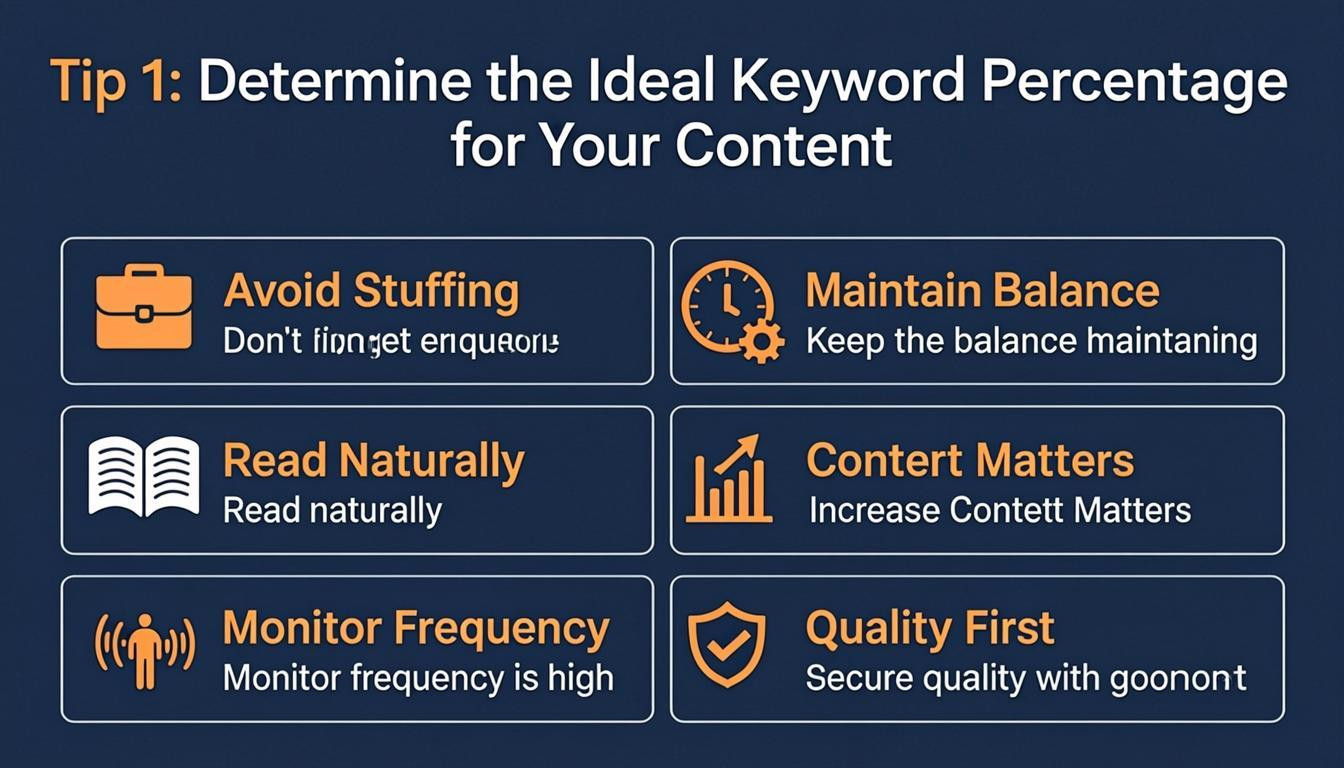
Tip 1: Determine the Ideal Keyword Percentage for Your Content
Figuring out the optimal keyword density helps you rank for your target terms without tripping any spam filters. While there isn't a magic number that works for every situation, aiming for a density between 1% and 2% is generally safe and effective for keeping your writing readable. Going above this range often leads to keyword stuffing, which search engines tend to penalize heavily.
How to implement
To calculate this, divide the number of times your keyword appears by the total word count, then multiply by
- So, for a 1,000-word article, you’d want your target phrase to show up roughly 10 to 20 times.
- Vary your placements: Try to include the keyword in the introduction, subheadings, and conclusion.
- Use synonyms: Mix in related terms like "keyword frequency" or "SEO optimization" to avoid sounding repetitive.
- Prioritize context: Make sure the keyword fits naturally within the sentence structure rather than forcing it in.
Writing for the user experience should always come before hitting a specific number, as high-quality content is still the biggest factor in ranking.
Tip 2: Prioritize Long-Tail Keywords for Natural Integration
Long-tail keywords are usually phrases of three or more words that mimic how people actually speak in real life. By focusing on these specific phrases, you answer user intent more precisely while lowering the risk of keyword stuffing. When you are writing about keyword density, using longer variations helps the content flow much better for readers. Search engines prefer this conversational approach because it provides context rather than just the simple repetition of a target term.
To put this strategy into action, try integrating long-tail variations into your headers and the first paragraph.
- Identify related questions: Look for queries like "how to calculate keyword density" or "ideal keyword percentage for SEO."
- Use them in subheadings: Structure your content to answer these specific questions directly.
- Weave them into body text: Use variations naturally within sentences so the reading experience stays smooth.
This method ensures your content stays comprehensive and user-focused without forcing an exact match phrase over and over again.
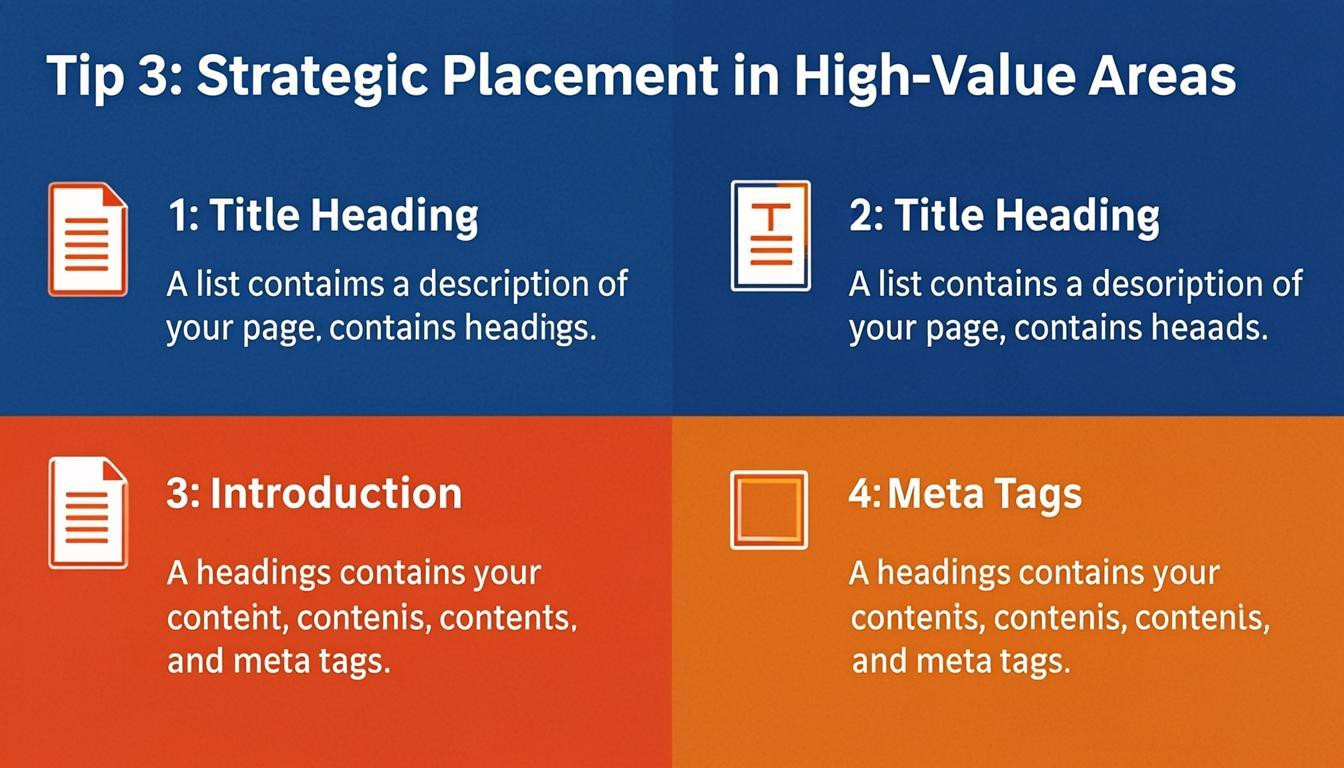
Tip 3: Strategic Placement in High-Value Areas
Understanding keyword density involves more than just calculating a percentage; it requires placing terms where search engines assign the most relevance. Strategic positioning signals the main focus of a page much better than random repetition does. The first 100 words of your content carry significant weight, making that area the perfect spot for your primary keyword. Additionally, using terms within subheadings creates a clear structural hierarchy that both algorithms and readers appreciate.
To make this work, focus your efforts on the most visible and weighted sections of your page structure. Instead of forcing keywords into every sentence, prioritize these specific high-value zones:
- Title Tag and Meta Description: Make sure the core term appears naturally here to improve click-through rates.
- H1 Header: This is the primary topic indicator and should definitely include your target phrase.
- Introduction: Weave the keyword into the opening paragraph to establish immediate context.
- H2 and H3 Subheaders: Break up your content while reinforcing relevance for crawlers scanning the page.
By concentrating keywords in these critical areas rather than spreading them too thin, you maximize their impact without risking over-optimization.
Tip 4: Use Synonyms and LSI Keywords to Enhance Context
Key detail Focusing solely on a single phrase often results in repetitive, unnatural writing that fails to satisfy search intent. Search engines have evolved to understand the semantic relationships between words, meaning they look at context rather than just counting exact matches. When discussing keyword density, it is vital to understand that relevance is now built through related terminology. Latent Semantic Indexing (LSI) keywords and synonyms help algorithms grasp the topical depth of your content without triggering keyword stuffing penalties.
How to implement To diversify your vocabulary effectively, identify terms closely related to your primary topic. For instance, if the target keyword is "keyword density," integrate variations like "keyword frequency," "SEO word count," or "text optimization ratio." Use these naturally within headers and body paragraphs to reinforce the subject matter.
- Brainstorm variations: List different ways users might search for your core topic.
- Use analogies: Compare the concept to something familiar to clarify meaning.
- Check bold terms: Review competitor articles to see which related terms they emphasize.
This approach creates a comprehensive narrative that signals expertise to both readers and search engines.
Tip 5: Focus on Readability and User Intent Over Metrics
Key detail
Search engines have come a long way and no longer rely on simple mathematical formulas to rank content. When looking at keyword density, it is crucial to understand that high usage rates do not guarantee top rankings. Modern algorithms prioritize semantic context and user satisfaction over repetitive keyword stuffing. Overusing exact-match phrases often leads to keyword cannibalization and a poor user experience, whereas natural language processing helps search engines understand topical relevance without artificial repetition.
How to implement
To optimize for modern search standards, prioritize the reader's journey through the content rather than chasing a specific percentage.
- Write naturally: Draft content that answers the user's query directly without forcing keywords into every sentence.
- Use synonyms and variations: Incorporate related terms and latent semantic indexing (LSI) keywords to build context.
- Structure for scannability: Use short paragraphs, bullet points, and descriptive headers to improve readability.
For example, instead of repeating "best running shoes" ten times, use variations like "top joggers," "performance sneakers," and "athletic footwear" to create a comprehensive and fluid narrative.
Conclusion
Understanding keyword density is essential for balancing on-page optimization with high-quality content creation. While tracking the frequency of target terms helps ensure relevance for search engines, focusing too much on a specific percentage often leads to keyword stuffing. Modern algorithms prioritize semantic context and natural language patterns over the precise repetition of exact-match phrases.
To achieve the best results, content creators should focus on readability and user intent rather than manipulating metrics. Here are the core points to remember:
- Prioritize natural integration: Use keywords where they fit grammatically, avoiding forced repetition.
- Focus on semantic variations: Incorporate synonyms and related terms to build topical authority without overusing the primary keyword.
- User experience matters: Write for human readers first, as engagement metrics influence rankings more than raw keyword counts.
Ultimately, knowing what keyword density is provides a useful baseline for SEO auditing, but it should not dictate the entire writing strategy. A balanced approach that combines technical awareness with compelling content delivers sustainable performance in search results.

Comments
0