

Introduction
Taking a close look at your website is essential if you want to stay visible in today's crowded digital landscape. A systematic review helps uncover technical errors, content gaps, and structural issues that might be holding back your performance in search results. Even a site that looks great can lose traffic and miss out on conversions without this kind of regular maintenance.
Following a clear seo audit step by step helps you focus on the most critical fixes that actually affect your bottom line. This methodical approach ensures you nail the basics—like site speed and mobile usability—before diving into more advanced optimization strategies.
The key benefits of a regular audit include:
- Enhanced User Experience: Finding and fixing broken links or slow-loading pages keeps visitors happy and engaged.
- Risk Mitigation: Uncovering toxic backlinks or security vulnerabilities protects your site from penalties.
- Competitive Edge: Analyzing keyword gaps helps you spot valuable search terms your rivals might be missing.
By treating an audit as an ongoing process rather than a one-time quick fix, you build a sustainable framework for long-term growth. Let's walk through exactly how to execute that process effectively.
Automate Your SEO Audit
Save time and spot errors instantly with Semrush’s comprehensive Site Audit tool.
Key 1: Crawlability and Indexability Check
A successful seo audit step by step starts with making sure search engines can actually access your content. If bots can't crawl your pages or index your files, your optimization efforts won't matter. You need to verify that search spiders can find your URLs without hitting barriers like broken links, redirect loops, or server errors.
To run this check, use tools like Google Search Console or specialized crawling software to simulate how bots view your site. Look at the "Coverage" report to find pages excluded from indexing and investigate any "Page Not Found" (404) errors. You should also audit your robots.txt file to make sure you aren't accidentally blocking important parts of your site. Additionally, inspect your HTTP headers to confirm that key pages return a 200 OK status instead of a "No Index" tag.
- Audit the robots.txt file: Ensure it does not disallow CSS, JavaScript, or key content pages.
- Check the `noindex` meta tag: Remove this tag from pages you want to rank in search results.
- Fix 4xx and 5xx errors: Update broken links and resolve server timeout issues immediately.
Key 2: Technical Site Architecture and URL Structure
A logical site architecture helps search engines crawl your content efficiently while distributing page authority effectively. Flat structures work best because they minimize click depth, keeping important pages no more than three clicks away from the homepage. This hierarchy improves crawl budget allocation and helps users navigate intuitively. Your URL structures should also be clean, descriptive, and consistent to reinforce semantic relevance.
To implement this during an seo audit step by step, follow these practical steps:
- Simplify hierarchy: Organize categories into broad silos rather than deep, nested subfolders.
- Optimize URLs: Use lowercase letters and hyphens to separate words, avoiding parameters, session IDs, or special characters.
- Implement Breadcrumbs: Add breadcrumb navigation to sitelinks to enhance internal linking and help users understand where they are.
- Secure HTTPs: Ensure all pages redirect to HTTPS to signal security and trustworthiness to search engines.
For example, change a complex URL like `example.com/prod?id=324` to `example.com/mens-running-shoes`. This clarity helps both indexing algorithms and the user experience.
Key 3: Page Speed and Core Web Vitals Analysis
Page speed directly impacts user experience and search rankings, making it a critical component of any comprehensive SEO audit step by step. Search engines prioritize pages that load quickly and provide a stable visual experience, measured specifically through Core Web Vitals. These metrics focus on loading performance, interactivity, and visual stability. For instance, a high Cumulative Layout Shift (CLS) score indicates that page elements move around as the site loads, which frustrates users who might accidentally click the wrong buttons.
To implement this analysis effectively, use tools designed to measure these specific performance indicators.
- Run a comprehensive audit using PageSpeed Insights to identify specific URLs failing the thresholds.
- Compress and serve images in modern formats like WebP to reduce Largest Contentful Paint (LCP).
- Minify CSS, JavaScript, and HTML files to decrease total payload size and improve Time to First Byte (TTFB).
- Explicitly define size attributes for images and video embeds to prevent layout shifts.
Regularly monitoring these metrics ensures the site remains technically optimized for both users and search algorithms.
Key 4: Mobile-Friendliness and Responsiveness
Ensuring your site performs flawlessly on mobile devices is a non-negotiable part of any comprehensive SEO audit step by step. Search engines use mobile-first indexing, meaning they predominantly look at the mobile version of your content for ranking and indexing. If your site is difficult to navigate on a smartphone, your search visibility will likely suffer, no matter how well it performs on desktop.
To implement this effectively, start by checking that your layout utilizes responsive web design, which automatically adjusts content to fit various screen sizes. Avoid common pitfalls like text that is too small to read without zooming or clickable elements placed too close together. During your audit, verify that all primary resources, such as CSS and JavaScript, are accessible and not blocked for mobile crawlers.
Practical steps to ensure mobile optimization include:
- Testing your site on multiple devices and orientations to identify layout breaks.
- Compressing images to ensure fast load times on cellular networks.
- Implementing touch-friendly navigation buttons that are at least 48x48 pixels.
Key 5: On-Page SEO and Keyword Optimization
Optimizing individual pages is a fundamental step in any comprehensive seo audit step by step. This process ensures search engines understand your content relevance while providing value to users. You need to verify that target keywords appear in critical HTML elements without succumbing to keyword stuffing. A well-optimized page balances technical requirements with readability.
To implement this effectively, execute the following actions:
- Title Tags: Ensure your primary keyword appears near the beginning of the title tag to signal immediate relevance.
- Meta Descriptions: Write compelling descriptions under 160 characters that include the target keyword to improve click-through rates.
- Header Hierarchy: Use H1 tags for main titles and H2 or H3 for subheaders, incorporating semantic variations of your keyword naturally.
- Image Attributes: Add descriptive alt text to all images, helping search engines index visual content and improving accessibility.
For example, if a page targets "organic coffee beans," the H1 might be "Best Organic Coffee Beans for Espresso," while an H2 could be "Roasting Profiles for Organic Beans."
Key 6: Content Quality and Search Intent
Search intent represents the primary goal a user has when typing a query into a search engine. To rank effectively, your content must align with the specific reason behind the search, whether it is informational, navigational, commercial, or transactional. High-quality content addresses this need directly without fluff, offering comprehensive answers that satisfy the user immediately. For instance, a query for "how to tie a tie" requires a step-by-step tutorial with images, whereas "buy running shoes" demands product pages and pricing.
To implement this, analyze the current top-ranking pages for your target keyword to understand the format and depth search engines prefer. Evaluate your existing content against these standards to ensure it provides superior value. Follow these steps to optimize your pages:
- Classify Intent: Determine if the intent is informational, commercial, or transactional.
- Gap Analysis: Check if competitors cover subtopics you missed.
- Update Structure: Use appropriate headers and bullet points to improve readability.
- Enhance Value: Add unique data, case studies, or expert insights that competitors lack.
Ensuring your content matches user intent is a critical part of any effective seo audit step by step.
Key 7: Internal Linking Strategy
A robust internal linking structure distributes link equity across your site and helps search engines understand your content hierarchy. This involves connecting your pages through descriptive anchor text, establishing a clear site architecture that allows both users and crawlers to navigate efficiently.
To implement this during an seo audit step by step, use a site crawler to visualize your link structure. Identify orphan pages that lack internal links and connect them to relevant parent categories.
- Use Descriptive Anchors: Replace generic phrases like "click here" with keyword-rich text such as "comprehensive guide to technical SEO."
- Link Deep: Avoid linking only to top-level pages like Home or Contact. Instead, direct users to deep, supporting content to boost its visibility.
- Fix Broken Links: Scan for 404 errors within your internal network and redirect them to appropriate live pages.
Ensure that your most important pages receive the highest volume of internal links, signaling their priority to search engine algorithms.
Key 8: Backlink Profile and Authority Analysis
A comprehensive backlink profile analysis is vital for assessing your site's credibility and identifying potential ranking roadblocks. Search engines evaluate the quantity and quality of inbound links to determine your domain authority, meaning a profile filled with toxic links can severely hinder your visibility. During this phase of the seo audit step by step process, you need to pinpoint low-quality or spammy referring domains that may trigger manual penalties or algorithmic filters.
To implement this analysis effectively, follow these steps:
- Export Your Link Data: Use a dedicated tool to gather a complete list of all backlinks, referring domains, and anchor texts.
- Identify Toxic Links: Scan for links from adult sites, gambling platforms, or link farms. Look for an unnatural over-optimization of exact-match anchor text.
- Evaluate Link Velocity: Ensure there are no sudden, unexplained spikes in link acquisition, which often indicates black-hat SEO tactics.
- Conduct a Gap Analysis: Compare your profile against top competitors to discover high-authority domains you should target for future outreach.
If you detect harmful links, compile them into a disavow file and submit it to search engines to clean up your digital footprint.
Key 9: UX Signals and Engagement Metrics
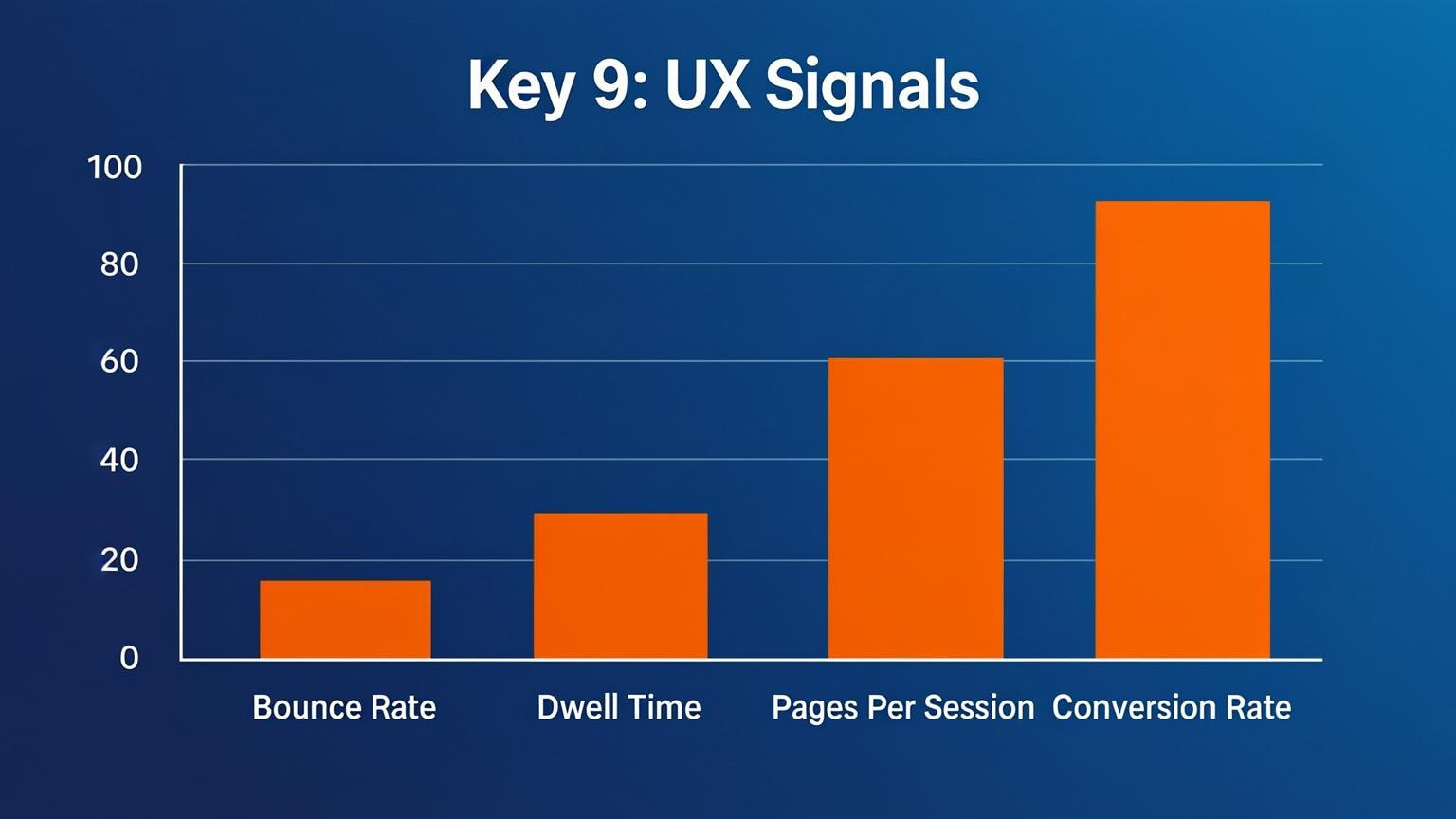
User experience (UX) signals provide direct insight into how visitors interact with your site and serve as critical quality indicators for search engines. When performing an seo audit step by step, analyzing behavioral metrics helps you identify content that fails to meet user intent or technical issues that disrupt navigation. For instance, a high bounce rate combined with a short average dwell time often suggests that the landing page content is irrelevant or the page load speed is too slow.
To improve these metrics, focus on enhancing site usability and content relevance.
- Optimize Core Web Vitals: Ensure mobile responsiveness and fast loading times to prevent users from abandoning the site prematurely.
- Improve Content Scannability: Use short paragraphs, descriptive subheadings, and bullet points to help users find information quickly.
- Strengthen Internal Linking: Guide users to related content to increase page views per session and time on site.
For example, replacing a wall of text with a structured "how-to" guide or adding a table of contents can significantly reduce pogo-sticking, where users bounce back and forth between search results and your site.
Key 10: Competitor Gap Analysis
Identifying where competitors succeed but your site fails is a critical component of a comprehensive seo audit step by step. This process reveals high-value keywords your rivals rank for that you currently do not, highlighting missed opportunities for traffic growth. By analyzing these content and keyword gaps, you can prioritize pages that offer the highest potential return on investment and adjust your strategy to capture market share.
To implement this effectively, start by identifying your top three to five organic competitors. Input their domains into a dedicated SEO tool to extract their top-ranking keywords. Filter this list to find terms where they rank in the top ten positions but your site is absent or ranks lower than position twenty. Use these insights to guide your content calendar. For example, if a competitor ranks well for a "how-to" guide related to your core product, create a superior, more comprehensive version of that content targeting the same search intent.
Conclusion
Executing an seo audit step by step allows you to identify technical weaknesses and content gaps that hinder your website's performance. By systematically addressing these areas, you establish a strong foundation for long-term organic growth and improved search engine visibility.
Key takeaways from this process include:
- Comprehensive Technical Health: You must verify that crawling, indexing, and site speed meet current standards to ensure search engines can access your content efficiently.
- Content Relevance and Structure: Aligning your keywords with user intent and organizing information through a logical hierarchy helps both users and search engines navigate your site.
- User Experience Optimization: Factors such as mobile responsiveness and intuitive navigation directly impact engagement metrics and rankings.
- Off-Page Authority: Evaluating your backlink profile reveals the strength of your domain's reputation and identifies potential toxic links.
Regular audits are essential, as search algorithms and competitor strategies evolve continuously. Treating this seo audit step by step as a recurring maintenance task rather than a one-time fix ensures your digital presence remains robust and competitive in the search results.

Comments
0