

The Myth of Being "Broken"
I know the feeling well. You look in the mirror and wonder, "Why can’t I just get it together?" Maybe you’re snapping at your partner over nothing, or you need three coffees just to feel human. It is so easy to internalize these struggles and decide there is something fundamentally wrong with who you are. But carrying that shame is heavy, and honestly, it doesn't belong on your shoulders.
Society loves to tell us that if we try hard enough, we can do it all. We see women bouncing back from babies, climbing career ladders, and keeping perfect homes. When you can barely keep your eyes open, that comparison cuts deep. You start labeling yourself as lazy or defective. But here is the truth: you’re not broken — something else is happening inside your body that you cannot see.
It is vital to stop confusing your character with your chemistry. So many symptoms we think are personality flaws are actually physiological cries for help.
- Brain fog isn't stupidity; it is likely low thyroid hormones affecting your cognitive function.
- Mood swings aren't you being "crazy"; they are often a nervous system response to metabolic stress.
- Exhaustion isn't a lack of discipline; it is cellular fatigue.
Your body isn't failing you on purpose. It is just responding to an internal environment that needs support, not judgment.
You’re Not Broken — Something Else Is Happening Physiologically
I know exactly how it feels to wake up feeling overwhelmed before your feet even hit the floor. You might feel like you’re constantly failing at "adulting," but here is the truth: you’re not broken — something else is happening deep inside your body. It’s not a character flaw; it is your nervous system trying desperately to keep you safe.
When your thyroid struggles, your communication lines get crossed, leaving your brain stuck in survival mode. Your emotional dysregulation isn't a lack of willpower—it is a biological response to a body that feels under constant siege. You are essentially driving a car with the emergency brake stuck on.
Look for these survival responses showing up in your daily life:
- Fight: Snapping at your partner or kids over small things like dirty dishes.
- Flight: Suddenly needing to clean the entire house or scrolling social media endlessly to escape.
- Freeze: Feeling paralyzed, unable to make simple decisions, or zoning out completely.
Past trauma can physically reshape how your brain reacts to stress today. If you experienced difficult events in the past, your brain may interpret a minor stressor—like a tight deadline or a rude comment—as a life-threatening danger. Your body reacts with a massive hormone surge because it thinks you are back in that dangerous situation. Understanding this physiology is the first step toward grace.
The Connection Between Gut Health and Mental State
Have you ever felt a knot in your stomach before a big presentation or gotten "butterflies" when you’re nervous? That isn’t just coincidence—it’s your gut and brain talking constantly. This direct line of communication, often called the gut-brain axis, plays a massive role in how you process emotions and handle stress. When your gut is out of balance, it can send confusing signals to your brain, leading to increased anxiety or mood swings that seem to come out of nowhere.
If you’ve been feeling foggy or forgetful, inflammation might be the sneaky culprit. Chronic inflammation in the gut can trigger a systemic response that impacts cognitive function, making it hard to focus or even find the right words. It’s incredibly frustrating, but you’re not broken — something else is happening inside your body that needs attention. Beyond inflammation, what you eat (or what you struggle to absorb) matters immensely.
Nutritional deficiencies can look suspiciously like mental health issues, making it easy to mistake a physical need for an emotional one. Consider these common imposters:
- Low Vitamin B12: Can mimic depression and cause severe fatigue.
- Low Iron: Often leads to brain fog and anxiety.
- Low Magnesium: Can manifest as irritability and trouble sleeping.
Addressing your gut health is often the missing piece in feeling like yourself again. When you heal your digestive system, you create a stable foundation for a calmer, clearer mind.
Environmental Factors Disrupting Your Balance
I know how easy it is to look in the mirror and blame yourself when you feel off, but you’re not broken — something else is happening. The world around us is throwing curveballs that directly mess with your thyroid, and often, the biggest culprit is chronic stress. When you are constantly running on adrenaline, your cortisol levels spike to keep you safe. This tells your body that survival is more important than reproduction or metabolism, effectively putting the brakes on your thyroid hormone production.
Then there is the sleep issue. We often mistake exhaustion for emotional instability or anxiety, but sleep deprivation physically alters how your brain handles stress and regulates hormones. If you wake up feeling frantic or tearful for no reason, it might just be that your body hasn't had the time it needs to reset its chemical balance. Finally, consider the hidden toxins in your daily life that act as endocrine disruptors. These sneaky chemicals can mimic thyroid hormones or block them entirely. Look out for these common triggers:
- Plastic food containers leaching chemicals into your meals, especially when heated
- Heavy metals found in certain household items or polluted water
- Synthetic fragrances in candles and cleaning supplies that interfere with hormone receptors
It is not all in your head; sometimes, it is simply the environment you are living in.
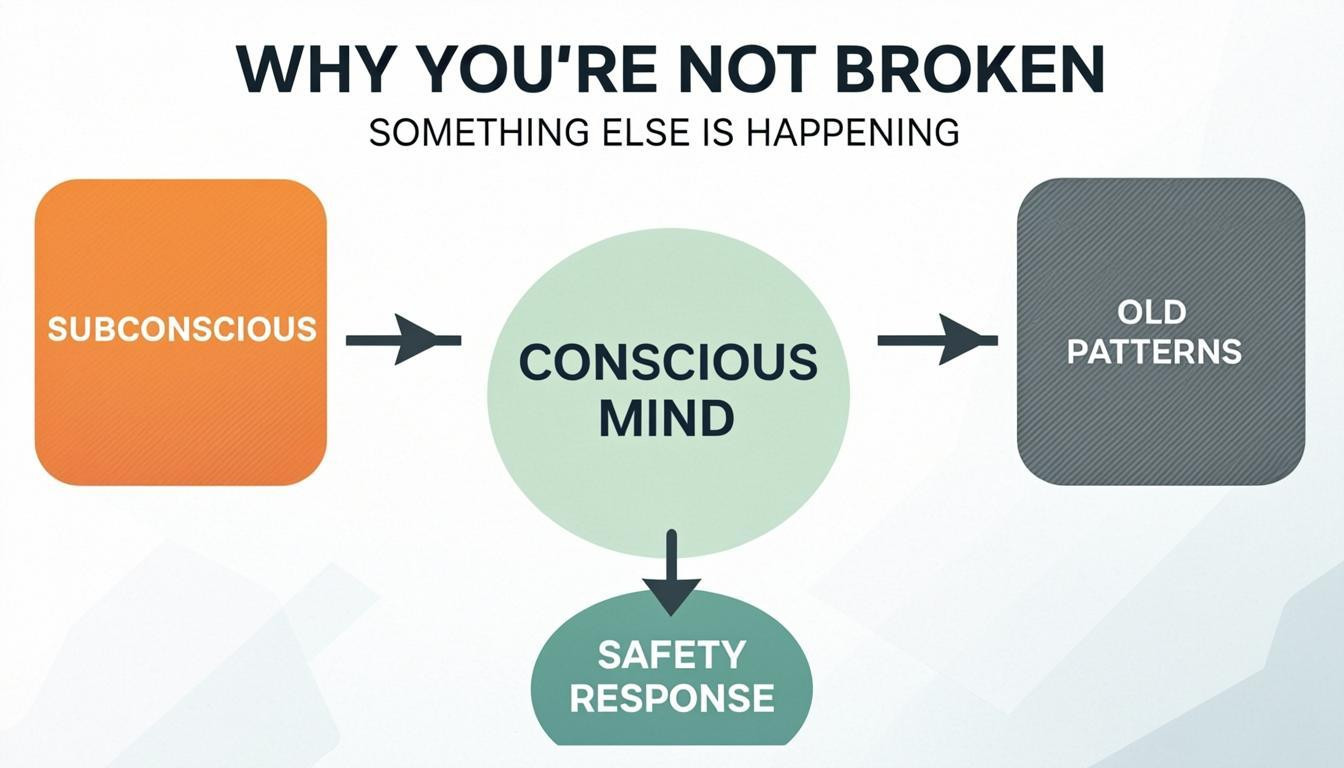
Why You’re Not Broken — Something Else Is Happening in Your Subconscious
I know exactly how it feels to spin your wheels, wondering why you can’t just stick to the plan that makes you feel better. Here is the truth: you’re not broken — something else is happening beneath the surface. Your subconscious mind is harboring deep-seated beliefs that often contradict your conscious goals. For instance, you might desperately want to heal, but a hidden part of you associates feeling better with a terrifying loss of identity or safety.
Your brain uses defense mechanisms to protect you, but they often end up holding you back. It feels like self-sabotage, but it is actually a misguided attempt to keep you safe from perceived threats like failure or even the pressure of success. These patterns form because your brain is biologically wired to conserve energy. It prefers the familiar, well-worn neural pathways over the effort required to build new ones.
To shift this dynamic, you have to gently coax your brain out of survival mode:
- Identify the loop: Notice when you repeat behaviors you know aren't serving you.
- Question the belief: Ask yourself what terrible thing might happen if you actually reached your health goals.
- Create safety: Reassure your nervous system that change is safe, not a threat.
You aren't failing; your brain is just doing its job too well. It is time to update its software.
Actionable Steps to Investigate the Root Cause
If you’ve been feeling off for a while, I want you to take a deep breath and remember this: you’re not broken — something else is happening. Your body is sending you signals, and our job now is to decode them. The path to feeling like yourself again starts with playing detective.
First, start keeping a detailed symptom and trigger journal. It doesn’t have to be fancy, but you need to track patterns. Note what you eat, how you sleep, your stress levels, and when symptoms flare up. You might notice that you feel exhausted after gluten or that your heart races during stressful meetings. These clues are gold.
Next, look beyond standard blood work and investigate underlying biological imbalances. While standard labs check basic thyroid function, deeper testing can reveal nutrient deficiencies, hormonal imbalances, or gut issues that are dragging you down. Consider checking for:
- Vitamin D and B12 levels to rule out fatigue causes
- Iron stores (ferritin) to ensure oxygen is reaching your cells
- Cortisol patterns to see if stress is wrecking your hormones
Support Your Thyroid Health
Stop blaming your character. Thyrafemme supports hormonal balance to help restore your natural energy and clarity.
Finally, consider consulting functional medicine and holistic practitioners. They look at the whole picture—your lifestyle, environment, and history—rather than just treating a number on a lab sheet. Finding the right practitioner who listens can be the turning point in your healing journey.
Shifting the Narrative from Brokenness to Adaptation
I know how easy it is to feel like your body has turned against you, but I want you to consider a different perspective. You’re not broken — something else is happening. Those frustrating symptoms you are experiencing? They aren't random malfunctions; they are messages. They are your body’s desperate attempt to communicate that it is struggling to keep up with the demands placed on it.
Instead of seeing your struggles as a failure, try viewing them as adaptive survival mechanisms. Your system is slowing down to preserve energy when it feels unsafe or depleted. It’s actually trying to protect you, even when it feels like it’s making life harder.
This shift in thinking changes everything, but embracing self-compassion during the healing process is crucial.
- Treat yourself with the same kindness you would offer a sick friend.
- Acknowledge that healing takes time and is not a linear path.
- Celebrate small wins rather than focusing on what you can't do yet.
When you stop fighting against your body and start listening to it, you move from a place of fear to a place of understanding. You aren't a machine that needs fixing; you are a human being who needs care and support to find your balance again.

Comments
0