

Introduction
Getting your content to rank high on search engines is all about finding the sweet spot between writing for algorithms and writing for real people. If you go overboard with repetitive terms, you risk triggering penalties that can wipe out your hard-earned rankings. Knowing how to avoid keyword stuffing is crucial because modern search engines care much more about context and user intent than simply counting how many times a word appears.
When you force keywords into text unnaturally, it makes for a terrible reading experience. People bounce off the page quickly, and search engines interpret that as a sign of low quality. To keep your authority and trust intact, you need to focus on depth and relevance rather than just repeating the same phrases. Good optimization looks like this:
- Using synonyms and related terms to build topical authority
- Prioritizing natural sentence structure over forcing exact-match phrases
- Writing primarily to answer user questions or solve problems
When you shift your focus from trying to manipulate the system to actually providing value, you safeguard your organic performance. Understanding this balance is the first step toward building a sustainable, long-term SEO strategy that can handle future algorithm updates.
Master Content Balance
Use Semrush's Writing Assistant to check for keyword stuffing and optimize your text for top rankings.
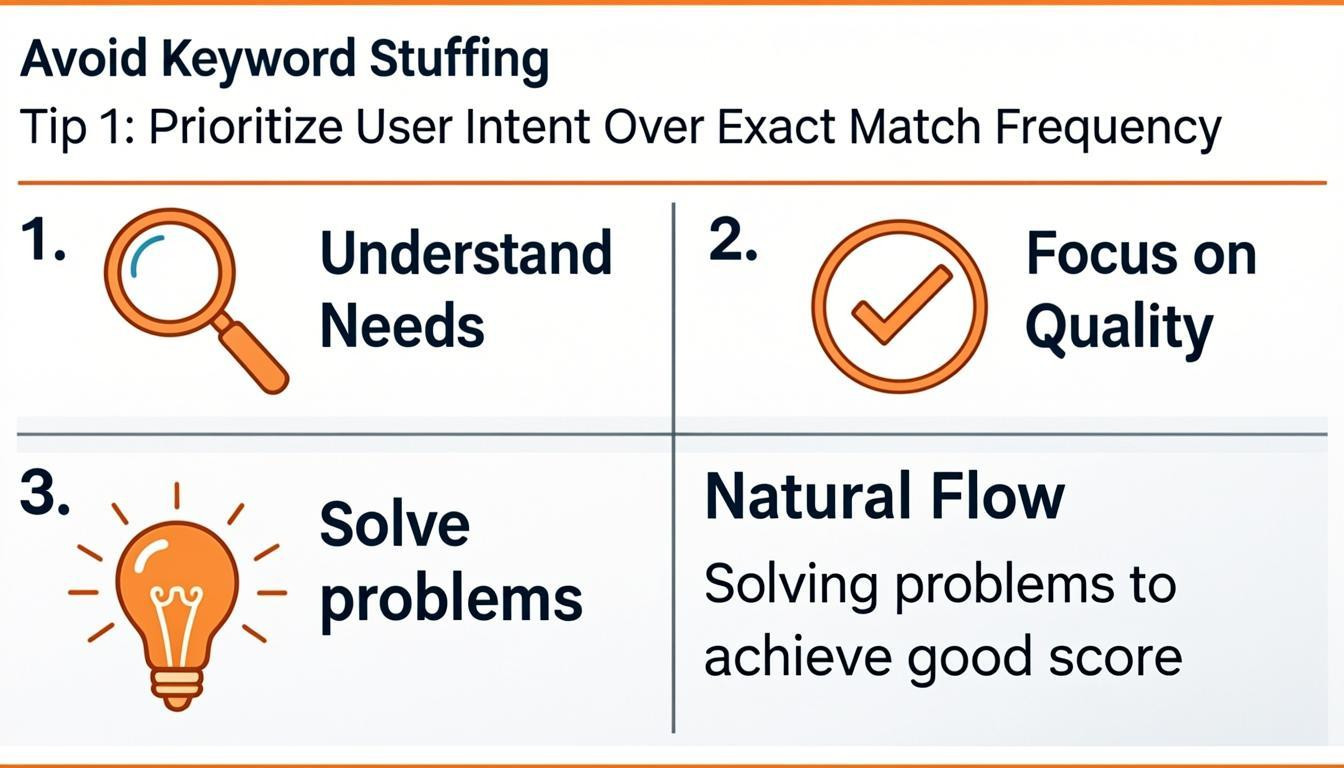
Tip 1: Prioritize User Intent Over Exact Match Frequency
Search engines have come a long way; they now understand the semantic meaning behind a query rather than just matching specific words word-for-word. If you focus solely on repeating a target phrase, you often end up with unnatural text that frustrates readers. On the other hand, if you address the underlying reason for the search, you’ll see better engagement and higher rankings.
Here is how to put this into action:
- Analyze the "why" behind the search. Figure out if users are looking to buy something, learn something new, or navigate to a specific page.
- Use variations and synonyms. Instead of repeating "how to avoid keyword stuffing" over and over, mix it up with phrases like "preventing content spam," "natural keyword usage," or "writing for readers."
- Focus on comprehensiveness. Answer the user's question thoroughly in the first paragraph, then expand on the details rather than forcing keywords into every single sentence.
For instance, if a page targets "best running shoes," the content should naturally discuss comfort, durability, and terrain types. This approach lets you integrate related terms without forcing the exact phrase, ensuring the content remains readable and valuable.
Tip 2: Calculate and Maintain Ideal Keyword Density
Finding the right balance is a big part of learning how to avoid keyword stuffing. Search engines prefer natural language integration over forced repetition. While there isn't a magic percentage that works for every piece of content, a density of roughly 1-2% is generally considered safe for most web pages. If you go much higher than this, you risk triggering spam filters, which can lead to lower rankings or even penalties.
To implement this strategy, focus on writing for your audience first rather than obsessing over exact numbers. You can use these steps to keep your usage in check:
- Count total words in your draft to establish a baseline.
- Identify keyword instances to see how often your target phrase appears.
- Calculate the density by dividing the keyword count by the total word count, then multiplying by
100.
- Read the content aloud to ensure the phrasing sounds conversational and fluid.
If the text sounds robotic or repetitive when you read it out loud, reduce the frequency. Instead, bring in semantic variations and synonyms to maintain relevance without over-optimizing.
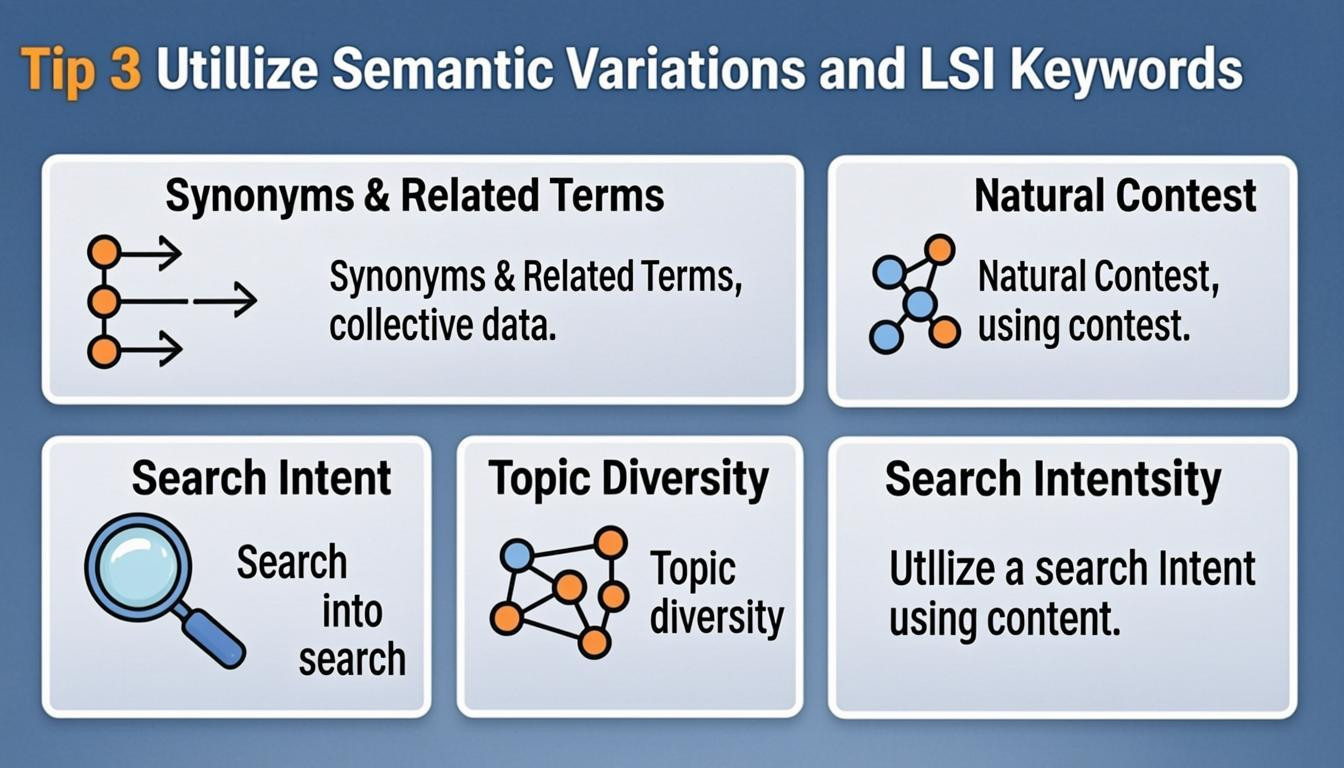
Tip 3: Utilize Semantic Variations and LSI Keywords
Today's search engines rely on sophisticated algorithms to understand context, user intent, and the relationships between concepts—they don't just count exact-match phrases. Integrating semantic variations and Latent Semantic Indexing (LSI) keywords helps algorithms really comprehend the depth of your topic. This signals to search engines that your page covers a subject comprehensively without needing to repeat a primary phrase in an unnatural way.
To make this work, identify synonyms and related terms that fit your topic naturally.
- Brainstorm related concepts: If you are targeting "how to avoid keyword stuffing," include terms like "over-optimization," "search engine penalties," "natural writing flow," and "user experience."
- Use long-tail phrases: Swap out repetitive exact matches for longer, conversational variations.
- Review "People Also Ask" boxes: Look at the common questions people ask to diversify your vocabulary.
For example, instead of writing "Our guide on how to avoid keyword stuffing shows how to avoid keyword stuffing for better SEO," try: "Our guide explores how to avoid keyword stuffing by focusing on natural content creation and preventing over-optimization penalties." Using a variety of terms keeps the text readable and authoritative.
Tip 4: Strategic Placement in Key Structural Elements
Search engines prioritize specific HTML elements to understand what a page is actually about. Strategic placement means inserting your target keyword into these high-priority areas rather than scattering it randomly throughout the text. This signals relevance to crawlers without needing excessive repetition, which is a core component of learning how to avoid keyword stuffing.
To do this effectively, focus on the document hierarchy and metadata. Make sure the keyword appears naturally in the following spots:
- Title Tag: Place the keyword near the beginning for maximum impact.
- H1 Header: Use it once in the main headline to establish the page's subject clearly.
- First 100 Words: Include the term early in the introductory paragraph.
- URL Slug: Incorporate a clean, readable version of the keyword.
- Image Alt Text: Describe visuals using the keyword where it makes sense contextually.
By concentrating your efforts on these structural anchors, you reinforce your topical authority. This approach reduces the pressure to overuse the phrase in the body content, which helps maintain a natural readability score for human users.
Tip 5: Enhance Readability with Varied Sentence Structure
Playing with sentence length and complexity is a powerful strategy when figuring out how to avoid keyword stuffing. Search engines favor content that flows naturally, and a rigid, repetitive rhythm often signals robotic writing or forced optimization. By alternating between short, punchy statements and longer, more complex sentences, you create a rhythm that keeps readers engaged and masks the presence of necessary keywords.
To implement this, analyze your paragraph structure during the editing phase. Avoid placing your target phrase at the start of every sentence. Instead, break up long blocks of text with brief, impactful sentences to improve the user experience.
- Combine short, related ideas into compound sentences to reduce choppiness.
- Use introductory phrases or dependent clauses to shift the keyword away from the sentence's beginning.
- Read your content aloud to spot any unnatural cadences caused by repetitive phrasing.
For example, transform a list like "We offer cheap SEO services. Our cheap SEO services help you rank. Buy cheap SEO services today" into a fluid narrative: "We offer affordable solutions to help you rank. Our top-tier SEO services drive traffic, making it easy to grow your business."
Conclusion
Mastering content optimization requires a strategic balance between targeting search terms and keeping your copy readable. The primary goal is learning how to avoid keyword stuffing while still signaling relevance to search engines. Overusing terms disrupts the user experience and can trigger penalties, which ultimately harms your visibility rather than helping it. Effective SEO focuses on creating natural, valuable content that satisfies user intent first and foremost.
Using semantic variations and long-tail keywords allows you to cover a topic broadly without falling into repetition. Instead of forcing a single phrase, you should integrate synonyms and related concepts that align with your core subject. For example, a page about "organic coffee" might naturally include terms like "fair trade beans," "brewing methods," or "sustainable farming" to provide necessary context.
Key takeaways for maintaining this balance include:
- Prioritize User Experience: Write for humans first, ensuring the text flows logically and engages the reader.
- Monitor Keyword Density: Keep target phrase usage moderate, aiming for natural placement rather than obsessing over a specific percentage.
- Use Synonyms: Diversify your vocabulary to avoid repetitive phrasing that looks like manipulation.
- Focus on Intent: Address the questions and needs of the audience rather than just chasing algorithms.
Sustainable growth relies on high-quality content. By sticking to these principles, digital marketers can achieve higher rankings and build lasting authority.

Comments
0