
Introduction
Stagnant rankings and declining traffic often signal that your current approach needs a fundamental overhaul. Many businesses continue with outdated tactics that no longer align with sophisticated search engine algorithms. If you want to learn how to fix SEO strategy, you must first identify the specific cracks in your foundation.
Common reasons for failure include focusing on keyword stuffing rather than search intent, neglecting technical health, or failing to produce high-quality content. A plan might fail because it targets keywords with impossible competition or ignores the user experience entirely. For example, optimizing strictly for exact-match keywords while ignoring semantic relevance can prevent your pages from ranking for broader, high-value queries.
Key indicators that your strategy is broken include:
- Keyword plateaus: High rankings that do not convert into traffic or leads.
- Technical debt: Slow page speeds and crawl errors that block search engine bots.
- Content decay: Outdated articles that no longer answer user questions effectively.
Addressing these issues requires moving away from quick fixes and toward a sustainable, data-driven methodology. You need to pivot your focus to holistic optimization, ensuring every element of your site works together to satisfy both user needs and algorithm requirements.
Fixe 1: Perform a Comprehensive Technical SEO Audit
To understand how to fix SEO strategy, you must first ensure search engines can access and interpret your website. A technical audit reveals hidden barriers preventing high rankings, such as crawl errors or indexing issues that render your content invisible. If bots cannot crawl your pages, your content optimization efforts are wasted.
Start by identifying specific roadblocks using tools like Google Search Console. Look for 5xx server errors, 404 not found pages, and blocked resources in the "Coverage" report. Additionally, check the "Robots.txt" tester to ensure you aren't accidentally disallowing critical pages.
To implement these fixes effectively, follow these steps:
- Submit a sitemap to Google Search Console to help bots discover your most important pages.
- Fix broken links by implementing 301 redirects to relevant, active pages.
- Optimize page speed by compressing images and leveraging browser caching to improve crawl efficiency.
- Ensure mobile-friendliness by checking that your site design is fully responsive on all devices.
Addressing these technical foundations creates a stable environment for your broader marketing tactics to succeed.
Fixe 2: Align Content with Search Intent
To effectively fix SEO strategy, content must match the specific motivation behind a user's search. Search intent generally falls into three main categories. Informational intent seeks answers or education, such as "how to tie a tie." Navigational intent targets a specific site or page, like "Facebook login." Transactional intent indicates a readiness to buy, with queries such as "buy running shoes online."
Aligning content with these intent signals prevents high bounce rates and improves relevance. To implement this, audit current top-performing pages to ensure the format matches user expectations. For informational keywords, use blog posts or guides. For transactional terms, prioritize product or landing pages.
Implementation steps:
- Analyze the top 10 search results for your target keyword to identify the dominant content format.
- Categorize your existing keywords by intent type.
- Rewrite or create content that directly answers the user's underlying goal, ensuring the format matches the intent.
Fixe 3: Optimize for Core Web Vitals
To learn how to fix SEO strategy, you must prioritize the technical performance of your site. Google's Core Web Vitals are specific metrics that measure real-world user experience, focusing on loading speed, interactivity, and visual stability. The three primary metrics to monitor are Largest Contentful Paint (LCP), First Input Delay (FID), and Cumulative Layout Shift (CLS). Improving these metrics directly correlates with higher search rankings and lower bounce rates.
Implementing these optimizations requires a mix of server configuration and frontend adjustments. Use the following steps to enhance your site's performance:
- Improve LCP: Optimize images by using modern formats like WebP and implementing lazy loading. Ensure your server uses a Content Delivery Network (CDN) to reduce latency for global users.
- Reduce FID: Minimize JavaScript execution time. Break up long tasks into smaller, asynchronous chunks and defer non-critical scripts.
- Stabilize CLS: Always include size attributes for images and video elements. Reserve space for ad containers and embeds to prevent layout shifts during loading.
Regularly audit your pages using PageSpeed Insights to identify specific bottlenecks and track your progress over time.
Fixe 4: Eliminate Keyword Cannibalization
Keyword cannibalization occurs when multiple pages on your website compete for the same search query. This confuses search engines, forcing them to choose which page to rank, often resulting in lower overall visibility for both. Instead of having one authoritative page, you dilute your link equity and ranking potential across several weaker URLs.
To identify this issue, perform a site search using `site:yourdomain.com "target keyword"`. Look for instances where two or more pages appear in search results for the same term. You can also check Google Search Console or SEO tools to see if different URLs are fluctuating for identical keywords.
To resolve cannibalization, follow these steps:
- Audit content: Identify which page has the highest traffic, backlinks, and conversions.
- Consolidate: 301 redirect lower-performing pages to the strongest, most comprehensive page.
- Update internal links: Ensure all internal links point to the primary URL to boost its authority.
For example, if you have three blog posts about "email marketing tips," merge them into one ultimate guide. This consolidates relevance and signals to search engines exactly which page to rank.
Fixe 5: Refresh and Update Outdated Content
Revitalizing stale blog posts with current data is a highly effective method when learning how to fix SEO strategy. Search engines prioritize accuracy and relevance, meaning content containing old statistics or obsolete information often loses rankings over time. By auditing existing articles for outdated facts and replacing them with fresh industry data, you signal to crawlers that the page is maintained and valuable. This approach is often more efficient than creating entirely new pieces, as the URL already possesses established authority and history.
Fix Your Broken SEO Strategy
Identify technical gaps and keyword opportunities with Semrush’s all-in-one site audit and competitor research tools.
To implement this strategy, begin by identifying high-potential pages that have experienced a decline in traffic or contain dated references. Update the publish date, rewrite introductions to reflect the current year, and swap out obsolete statistics with the latest figures. Ensure all internal and external links still function and point to relevant, active sources. For example, a "Best Marketing Tools" list post from 2020 should be revised to include new market leaders and remove discontinued software. This maintains user trust and improves engagement metrics.
Fixe 6: Strengthen Internal Linking Structure
Distributing page equity efficiently is a core component of learning how to fix seo strategy. Internal links pass authority from high-performing pages to newer or less visible content, signaling to search engines which pages are valuable. Without a robust structure, important pages may remain buried, limiting their ability to rank.
To implement this effectively, conduct an audit to identify orphan pages—URLs with no incoming internal links—and connect them to relevant content. Focus on contextual linking rather than relying solely on navigation menus. For example, if a comprehensive guide on your homepage ranks well, link specific keywords within that text to deep-dive articles on the same topic. This creates a topical cluster that boosts relevance for the entire site.
Use descriptive anchor text that accurately describes the target page to aid both users and search engine crawlers. Prioritize linking from pages with high traffic and authority directly to pages that need a ranking boost. Regularly updating old posts with links to fresh content ensures equity continues to flow throughout your domain.
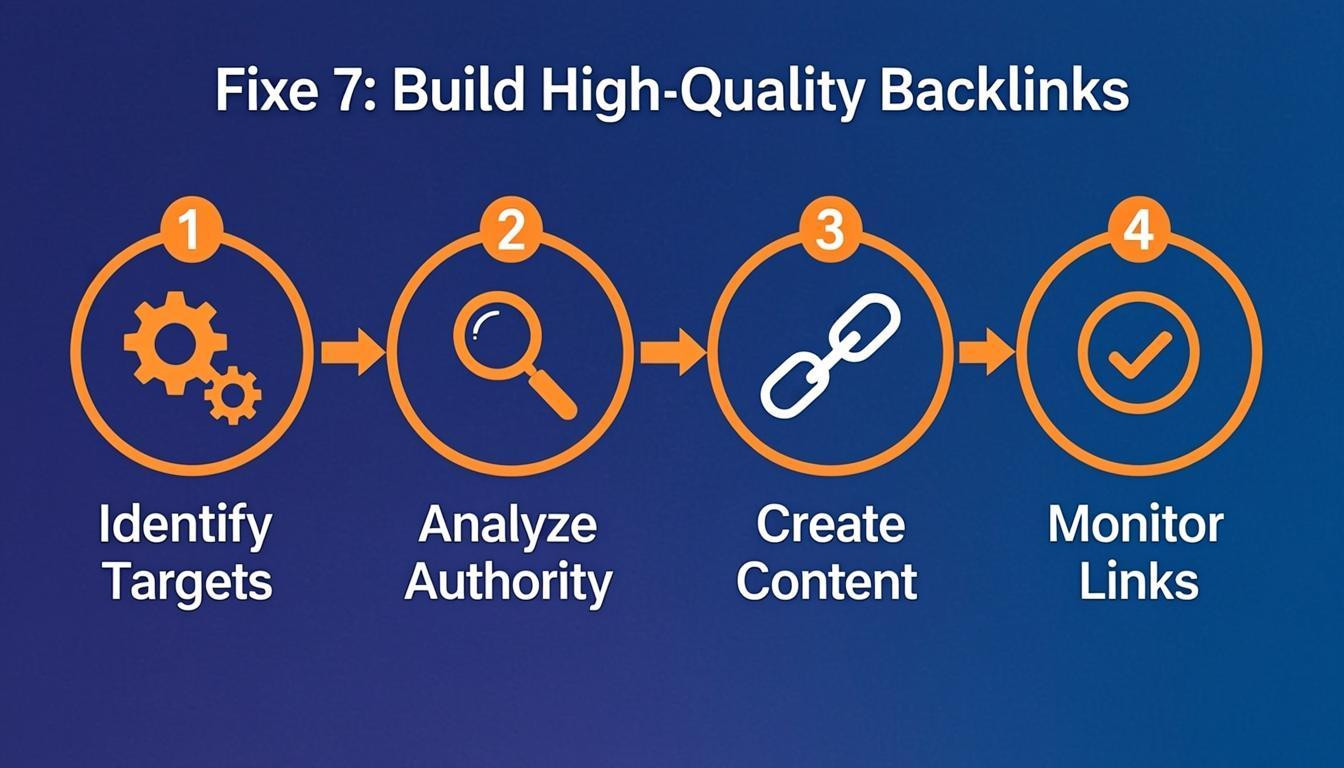
Fixe 7: Build High-Quality Backlinks
When refining how to fix SEO strategy, securing authoritative backlinks remains a critical factor for improving search visibility. However, not all links carry equal weight. Prioritizing relevance over sheer quantity ensures that search engines understand your site’s niche and authority. A single link from a respected industry leader often outweighs dozens from unrelated, low-quality directories.
To implement this effectively, focus on earning editorially placed links rather than manipulating metrics. Start by identifying high-authority domains within your specific industry.
- Create linkable assets: Develop comprehensive guides, original research studies, or infographics that naturally encourage others to reference your content.
- Digital PR: Pitch unique data or expert insights to journalists and bloggers who cover topics relevant to your business.
- Broken link building: Find broken links on reputable sites and offer your content as a functional replacement.
- Guest posting: Contribute valuable articles to trusted industry publications to earn contextual links within the body content.
Consistently pursuing these relevant, high-quality signals strengthens your domain authority and supports long-term ranking stability.
Conclusion
Fixing a broken SEO strategy requires a shift from quick fixes to sustainable, data-driven processes. To learn how to fix SEO strategy effectively, you must prioritize technical health, content relevance, and authority building simultaneously. Without a holistic approach, individual optimizations often fail to generate significant traffic growth.
For immediate results, focus on the following actionable steps:
- Audit Core Web Vitals: Identify and resolve technical issues like slow loading speeds or mobile usability errors that directly impact rankings.
- Refresh High-Value Content: Update outdated articles with current data and expanded keyword coverage to regain lost visibility.
- Disavow Toxic Links: Review your backlink profile and remove or disavow spammy links that may trigger search engine penalties.
- Align with Search Intent: Ensure your landing pages answer the specific questions users are asking, matching the format they expect.
Long-term success depends on consistent monitoring and adaptation. Algorithms evolve, and competitor strategies change, requiring regular performance reviews. By establishing a routine for analysis and optimization, you create a resilient framework that withstands market fluctuations and drives sustained organic growth.
Comments
0