

Introduction
Effective search engine optimization really comes down to the quality, structure, and relevance of the information you present to users. When content misses the mark technically or fails to meet user expectations, it creates significant seo content problems that stop organic growth in its tracks. These issues usually pop up when there is a mismatch between what a user is searching for and what the page actually provides, leading to poor engagement and reduced visibility.
Fixing these challenges is essential if you want to build a sustainable digital presence. Search engines prioritize content that clearly demonstrates expertise, authoritativeness, and trustworthiness. If a website is full of duplicate material, stuffed with keywords, or just lacks substance, algorithms will naturally push those pages down in favor of more valuable resources.
Some of the most common obstacles that get in the way of optimal performance include:
- Keyword cannibalization, where several of your own pages end up fighting for the same search terms
- Thin content that offers very little value or depth to the reader
- Poor structure that makes it difficult for search engine crawlers to properly index the site
- Outdated information that causes users to lose trust
By systematically finding and fixing these flaws, businesses can improve their rankings and provide a much better experience for their audience. Let's explore the most frequent pitfalls and look at actionable strategies to correct them.
Fix Your SEO Content Issues Fast
Identify keyword cannibalization and thin content instantly with Semrush's Site Audit tool. Optimize for rankings today.
Fixe 1: Resolving Keyword Cannibalization
Keyword cannibalization happens when multiple pages on your website start competing for the exact same search query. This confuses search engines, forcing them to decide which single page to rank, which often results in lower positions for all the pages involved. Instead of consolidating authority, your site ends up diluting its ranking potential across several URLs. For example, if you have a blog post titled "Best Running Shoes" and a separate product category page for "Best Running Shoes," Google might struggle to figure out which one actually serves the user's intent best.
To get out of your own way, you need to consolidate content so there is a single, authoritative source for each topic. Follow these steps to fix cannibalization:
- Audit your rankings: Use site search operators or rank tracking tools to spot multiple URLs ranking for the same keyword.
- Evaluate performance: Compare traffic and engagement metrics to see which page is actually performing the best.
- Merge or redirect: Combine the content from weaker pages into the strongest one and set up 301 redirects to send all traffic to the consolidated URL.
- Update internal links: Make sure every internal link on your site points to the new primary page to give its authority a boost.
Fixe 2: Refreshing Outdated Content
Search engines love freshness and accuracy, which makes outdated material a very common seo content problem. If an article references old statistics, tools that no longer exist, or events from the distant past, it loses authority and rankings. To fix this, perform a content audit to find pages with declining traffic or information that is older than two years. Pay special attention to "evergreen" topics where accuracy matters most, like how-to guides or industry definitions.
You can implement updates by following these steps:
- Update statistics: Swap out old data points with figures from the current year.
- Check screenshots: Replace any images showing old interfaces or dashboards with current ones.
- Add new sections: Bring in recent trends or subtopics that have emerged since you originally published the piece.
For instance, a 2021 guide on "Social Media Trends" should be revamped to include current platform features and recent algorithm changes. Once you have made the revisions, update the "Last Updated" date and submit the URL to search console for re-crawling. This helps revitalize the page and signals relevance to both users and search algorithms.
Fixe 3: Optimizing for Search Intent
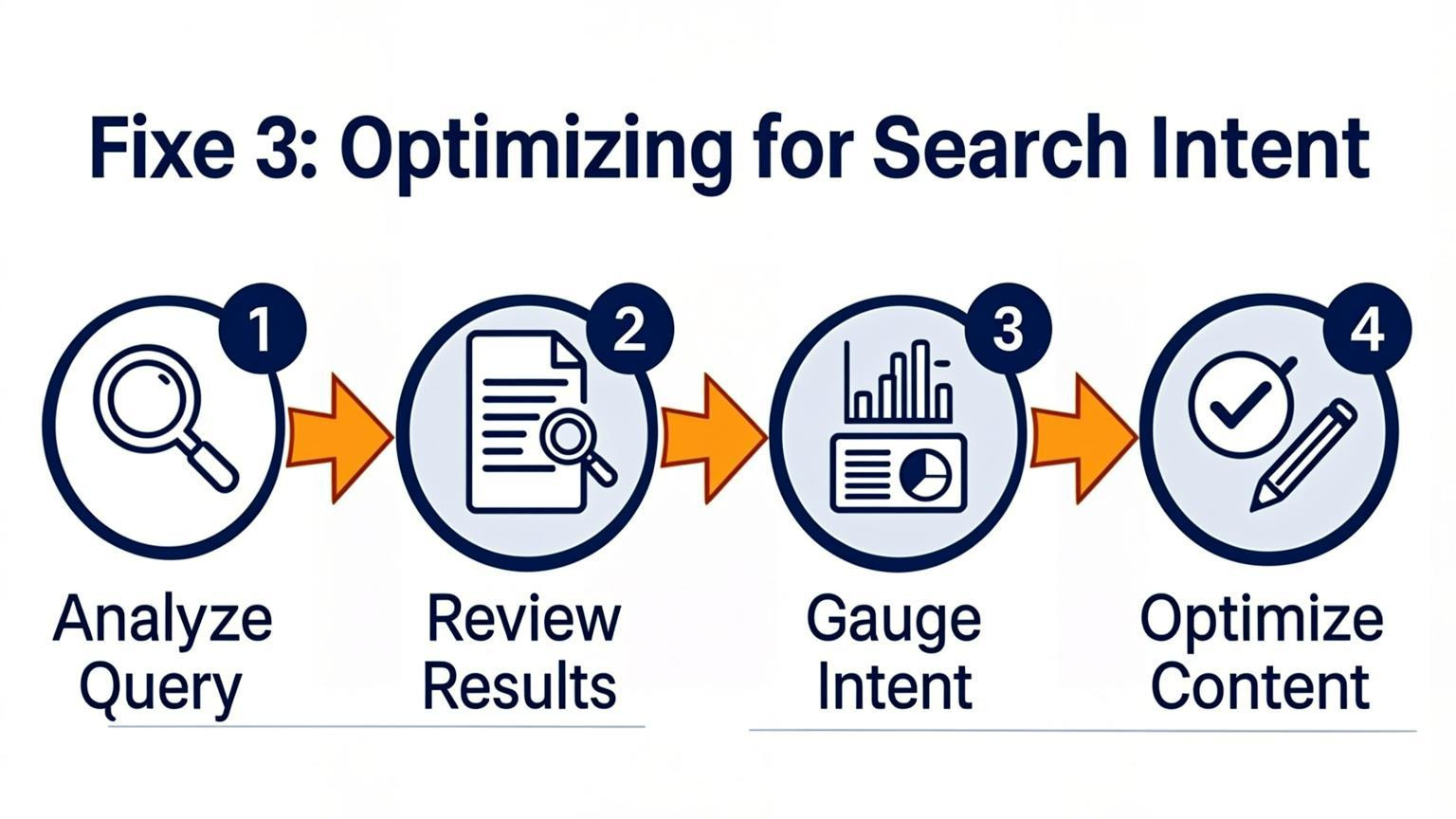
Optimizing for search intent is crucial when dealing with seo content problems. It isn't enough to just use the right keywords; you need to understand why someone is searching in the first place. Users generally fall into four categories: informational (looking to learn), navigational (looking for a specific site), transactional (ready to buy), and commercial investigation (comparing products). If your content doesn't match the specific intent behind the query, users will likely leave immediately, sending negative signals to search engines.
To align your content with user intent, analyze the current top-ranking results for your target keywords. Are they product pages, long-form guides, or short definitions? Structure your content to match the format and depth that is currently winning in the search results. If a user is looking for a quick answer, a brief summary is better than a wall of text. Conversely, if they are researching a complex topic, they will expect a detailed, comprehensive guide. Matching this intent keeps users on the page longer and tells search engines your content is the right fit.
Fixe 4: Improving Content Readability
Search engines care a lot about user experience, and dense blocks of text are a major seo content problem. If visitors struggle to scan your content, bounce rates go up, which signals lower quality to algorithms. Readability directly impacts how well users engage with your information and how search engines interpret the structure of your page.
To fix this, structure your writing so people can scan it quickly and understand it easily. Break long paragraphs into smaller chunks of two or three sentences and use bullet points for complex lists. Use descriptive subheadings to organize topics logically and guide the reader through the narrative. For example, instead of writing a 200-word paragraph defining technical terms, use a bulleted list with the terms bolded for emphasis.
Key implementation steps include:
- Sentence length: Try to keep sentences under 20 words.
- Vocabulary: Swap out industry jargon for plain language whenever possible.
- Formatting: Use bold text to highlight key takeaways.
By simplifying the language and visual structure, you ensure the content is accessible to a wider audience while signaling topical relevance to search engines.
Fixe 5: Fixing Thin Content Issues
Thin content acts as a significant barrier to ranking well in search results because it fails to provide the comprehensive information users are looking for. This issue usually shows up as pages with very little text, content syndicated from other sources, or doorway pages created solely for search engine indexing. To address this, you need to conduct a content audit to find pages with low word counts or superficial value.
How to implement
- Perform a site audit: Use crawling tools to identify pages with fewer than 300 words or those flagged as having low content quality.
- Consolidate similar pages: Merge multiple weak pages covering the same topic into one authoritative, comprehensive pillar post. Redirect the old URLs to preserve any existing authority.
- Expand with depth: Rewrite shallow sections by adding original research, FAQs, and step-by-step tutorials.
- Remove or noindex: If a page provides no value to users and cannot be improved, consider removing it entirely or applying a noindex tag to prevent it from affecting your crawl budget.
For example, instead of having five separate short pages on "running shoes," combine them into a single, robust guide covering types, terrains, and reviews.
Fixe 6: Eliminating Duplicate Content
Duplicate content confuses search engines, forcing them to choose which version of a page is the most relevant. This can dilute your ranking signals and hurt your visibility. This issue often comes up because of URL parameters, printer-friendly versions of pages, or syndicated content, causing two or more pages to compete against each other. To resolve this, you need to establish a clear canonical hierarchy across your domain.
Implement the following technical solutions to consolidate authority:
- Use 301 Redirects: Permanently redirect duplicate pages to the primary, authoritative URL.
- Apply Canonical Tags: Add a rel="canonical" link element in the head of duplicate pages that points to the original version.
- Handle Parameters: Configure Google Search Console to ignore specific URL parameters that are used for sorting or tracking.
- Consistent Internal Linking: Ensure all internal links point to the single preferred version of the URL to prevent confusion.
For instance, if `example.com/shoes` and `example.com/shoes?color=red` display the same content, the latter should canonicalize to the former. This consolidation is essential for solving common seo content problems and ensuring your crawl equity is preserved.
Fixe 7: Strengthening Internal Linking
A strong internal linking structure ensures search engines can discover, index, and understand the relationship between your pages. This architecture distributes page authority throughout your site, helping newer or less visible content rank better. Without sufficient internal links, valuable pages often remain isolated, failing to gain the traction needed to resolve common seo content problems.
To implement this effectively, audit your content to find "orphan" pages that lack inbound links. Strategically link from high-authority "pillar" pages to relevant supporting articles using descriptive, keyword-rich anchor text. Avoid generic phrases like "click here" and prioritize contextually relevant connections that actually help the user navigate.
- Identify content gaps: Find relevant topics mentioned on your site that do not yet have a dedicated link.
- Update older posts: Regularly revisit high-traffic articles to insert links to recently published content.
- Use Breadcrumbs: Implement breadcrumb navigation to reinforce site hierarchy and improve user orientation.
Conclusion
Addressing seo content problems is essential for maintaining visibility and driving organic traffic. Many websites struggle simply because they fail to align their output with user intent or technical requirements. By identifying and rectifying these issues early on, you can build a sustainable strategy that withstands algorithm updates and helps you outperform competitors.
Key takeaways include:
- Prioritize quality over quantity: Thin or duplicate content rarely ranks well. Instead, focus on creating comprehensive resources that thoroughly answer user queries.
- Optimize for search intent: Ensure your content matches the reason behind a search, whether the user is looking for information, a specific product, or a transactional page.
- Fix technical basics: Resolve issues like slow loading speeds, broken links, and poor mobile responsiveness to ensure search engines can crawl and index your site efficiently.
- Refresh outdated assets: Regularly updating older posts with current data and relevant keywords can revive their rankings and utility.
Proactively managing these elements transforms your content into a powerful asset for growth.

Comments
0